
A How To Guide: Comparing Fractional CMO Services

By the time most founders call me, they've already sat through three to five pitches from other fractional CMOs. The decks look identical. The promises rhyme. Everyone has a "proven framework," a "growth playbook," and a roster of logos arranged in a tidy grid. And yet most leaders walk out of those calls more confused than when they walked in.
That's not an accident. The fractional CMO market expanded faster than its standards did. In 2020, you could count the serious operators on two hands. In 2026, anyone who held a marketing title for a few years can spin up a Wix site and call themselves a fractional CMO by Tuesday. The supply side is noisy. The buying side is undertrained. And the cost of getting it wrong — six to twelve months of wasted strategy, a demoralized team, and a category position you have to claw back — is significantly higher than the line item on the invoice.
I've been on both sides of this market. I ran a B2B agency for 17 years before selling it and moving into fractional work, which means I've sat across the table from buyers as a vendor and across the table from vendors as a buyer. The framework below is what I'd use if I were the one writing the check.
Pricing Models: What You're Actually Paying For
Most fractional CMO pricing conversations focus on the wrong number. The question isn't "how much per month" — it's "what does that number actually buy, and where does the model break?"
Here's how the five common pricing structures actually work.
Hourly
Hourly billing sounds transparent. It rarely is. A senior fractional CMO charging $300–$600 an hour will, in practice, log every meeting, every Slack thread, and every "quick review." You'll get the granularity you asked for and the friction you didn't. Worse, hourly engagements quietly disincentivize strategic work — because thinking time is harder to invoice than tactical execution, you'll often see deliverables-heavy time logs and strategy-light outcomes.
Use it when: You need short, defined consulting (a positioning audit, an org design review) and the scope genuinely won't expand.
Monthly Retainer
The dominant model — and the one with the most variance in what you actually receive. A $10K/month retainer might mean 30 hours of senior time, or it might mean four hours of the senior plus 26 hours of a junior you didn't know existed. Reputable operators define the deliverables and the cadence; less reputable ones define a "scope of services" so vague it could mean anything.
The hidden risk: retainers are designed to renew. The longer the engagement, the less incentive the CMO has to work themselves out of a job. I'll come back to this in the contract section.
Hybrid (Retainer + Project)
A baseline retainer for ongoing strategy, leadership, and team enablement, plus discrete project fees for things like a website rebuild, a category launch, or an ABM program build-out. When structured well, this is the cleanest model — you pay for the standing function and pay separately for the lift.
When structured badly, it's a Trojan horse for endless add-ons.
Project-Based
Defined scope, defined timeline, defined deliverable, defined fee. Useful for one-time engagements (a go-to-market strategy, a brand repositioning) but a poor fit for the ongoing leadership a fractional CMO is supposed to provide. If a vendor only sells project work, they're a consultant — not a fractional CMO. Those are different jobs.
Equity-Based
Rare, and usually a red flag in 2026 unless you're pre-revenue and the CMO is genuinely betting on you. Most experienced fractional CMOs won't take equity-only deals because the time horizon for a meaningful exit is incompatible with the way fractional work actually scales. If someone is pitching you a 100% equity arrangement, ask why their cash pipeline doesn't support a normal engagement.
Pricing Model Comparison
Model | Typical Range (US, 2026) | Best For: | Where It Breaks |
Hourly | $300–$600/hr | Short, defined consulting | Strategic underinvestment, billing friction |
Monthly Retainer | $8K–$25K/mo | Ongoing leadership | Vague scope, perverse renewal incentives |
Hybrid | $6K–$15K base + project fees | Standing function + episodic lifts | Add-on creep |
Project-Based | $15K–$150K per project | One-time strategic work | Not real fractional leadership |
Equity-Based | Variable | Pre-revenue, mission-aligned | Misaligned time horizons |
When you compare fractional CMOs on pricing, normalize the unit. Convert everything to effective hourly cost of senior time and ask what's included versus what triggers a change order. The headline number is rarely the real number.
Selection Criteria: Beyond the Pitch Deck
Fractional CMO selection criteria fall into two buckets: things every vendor will tell you they're great at, and things you actually need to vet for. Here's the second bucket.
Expertise Fit
Industry experience matters more than people admit. A fractional CMO who has scaled SaaS won't automatically translate to industrial manufacturing — the buyer journey, channel dynamics, and sales cycle are different sports. Probe past the logos: what did they actually own in those engagements, and what was the measurable
outcome? "Advised on growth strategy" can mean anything.
Stage fit is the second filter. Someone who built marketing for a $200M company starting from a mature foundation may be the wrong hire for your seed-stage motion, and vice versa.
Operational Style
There are two species of fractional CMO: the strategist and the operator. The strategist sets direction, builds the plan, and hands execution to your team. The operator gets in the weeds — runs your weekly marketing standup, edits the campaign brief, sits on customer interviews.
Neither is better. They serve different needs. The mismatch is the failure mode: hiring a strategist when you have no team to execute, or hiring an operator when you needed a board-grade voice in your strategy meetings.
Communication Cadence
Ask exactly: how often will we meet, in what format, with what artifacts? "We're flexible" is not an answer — it's a deferral. The good engagements have a defined operating rhythm: weekly leadership 1:1, biweekly team reviews, monthly stakeholder readout, quarterly strategy session.
If they can't articulate this in the discovery call, they haven't run it before.
Reporting Structure
Who do they report to? Who do they hold accountable? In a real fractional CMO engagement, they sit on your leadership team — not adjacent to it. If they're being treated as a vendor rather than an executive, the role won't deliver what you're paying for.
Team Access
If your fractional CMO is also pitching their agency's services, you have a conflicts problem. Some of the largest fractional CMO firms are agencies in disguise — the fractional engagement is a wedge to sell you implementation. That's not always bad, but you need to know what you're buying. Ask directly: "If you recommend a website rebuild, who do you recommend, and what's your financial relationship with them?"
Red Flags
A few signals that have predicted bad engagements in my experience:
They can't name a client they fired or were fired by
Their case studies are all attribution claims, no methodology
They won't share references from the last 12 months
Their "team" is a stock-photo about page
They start strategy work before they've understood your sales motion
They quote you in the first call
Contract Terms: The Clauses That Matter
Most fractional CMO contracts are written by the vendor, for the vendor. Push back on the following before you sign.
Exclusivity
Many fractional CMOs work with multiple clients simultaneously — that's the model. But you should know who else they're working with, in what category, and what happens if a direct competitor signs on after you do. A non-compete clause covering your immediate competitive set is reasonable to ask for. If they refuse, ask why.
Notice Period
Standard is 30 days, either side. Anything longer than 60 days for the client-side termination should make you nervous — that's a vendor protecting their MRR, not a partner committed to outcomes. Watch for auto-renewal clauses with short cancellation windows.
Scope Creep Boundaries
The scope section is where most engagements fail. It should specify:
What deliverables are included in the retainer
What categories of work trigger a change order (and at what rate)
How discovery and onboarding are handled (and billed)
Whether their team or yours owns execution
If the scope is written in marketing-speak ("provide strategic marketing leadership and ongoing guidance"), rewrite it. Specificity protects both sides.
Performance Expectations
Here's the uncomfortable truth: it's hard to write performance clauses for marketing leadership the way you can for sales. But you can define leading indicators — pipeline contribution, content velocity, attribution maturity, team capability building — and tie a portion of the engagement to them. A fractional CMO who refuses any form of accountability is selling you optionality, not outcomes.
What "On-Call" Means
"On-call" is the most abused phrase in fractional CMO contracts. Get it defined in writing: response times, hours of availability, escalation paths, and what happens when they're traveling or with another client. If "on-call" means "I'll respond within 48 hours during business days," that's fine — but you need to know that before you have a category-launch crisis on a Friday afternoon.
IP and Asset Ownership
Strategy documents, frameworks, audience research, customer interviews — who owns them at the end of the engagement? Default contracts often leave this ambiguous, which means your competitive intelligence walks out the door with the CMO. Specify ownership and transition obligations explicitly.
Fractional vs. Full-Time: The Honest Tradeoffs
The fractional CMO vs full-time CMO comparison usually starts and ends with cost. That's a bad place to start. The real comparison is about what kind of marketing function your business actually needs at this stage.
When Fractional Makes Sense
You need senior-grade strategy but don't yet have the volume of work to justify a full-time leader
Your marketing function is being built from scratch and you need someone who has done it before
You're in transition (between full-time CMOs, post-acquisition, pre-Series B)
You need a specific expertise injection (category creation, repositioning, channel build) for a defined window
When Fractional Fails
You need someone who is going to be in the building, with the team, every day
Your marketing operations are deeply intertwined with sales, product, and customer success in ways that require constant cross-functional presence
The engagement requires deep institutional knowledge that takes years to build
You're at a stage where the CMO needs to be a public face of the company in a sustained, high-visibility way
The Hidden Costs of Each
The hidden cost of the full-time CMO is the all-in package — base, bonus, equity, benefits, recruiting fees, and the 6–9 months of ramp before they're operating at full capacity. That number is often 3–5x the line-item base.
The hidden cost of the fractional CMO is continuity. Even the best fractional engagement ends. When it does, the institutional knowledge that should belong to your company has to be deliberately transitioned — and most engagements don't plan for this. If you don't build internal capability during the engagement, you'll be starting over when it ends.
Continuity and Skin in the Game
This is the question I'd want answered most clearly if I were buying: how does this person's incentive structure align with my long-term outcomes, given that they'll be gone in 12–24 months?
The good fractional CMOs build for their own obsolescence. They document the strategy, train the team, hire your eventual full-time replacement, and structure the handoff before you have to ask. The bad ones extend retainers indefinitely. You can usually tell which kind you're buying by month four.
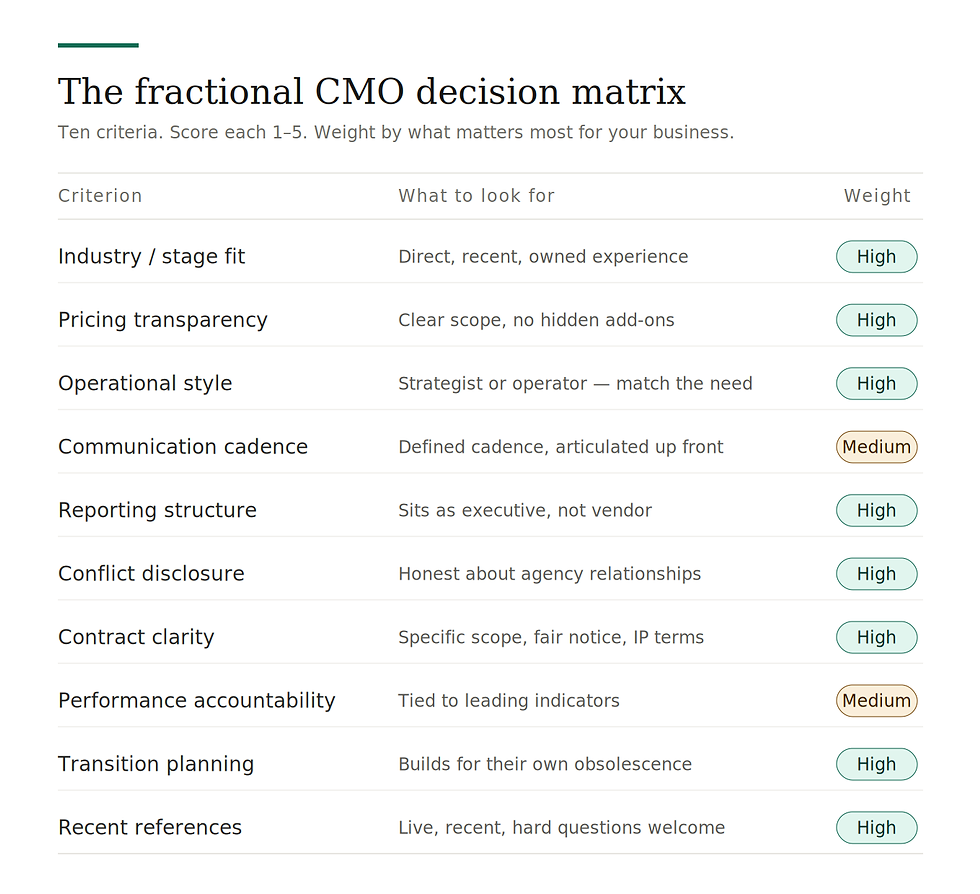
Decision Matrix
Use this to score the fractional CMOs you're considering. Rate each criterion 1–5; weight by what matters most for your business.
Criterion | What to Look For | Weight |
Industry/stage fit | Direct, recent, owned (not advised) experience | High |
Pricing transparency | Clear scope, defined deliverables, no surprise add-ons | High |
Operational style match | Strategist vs operator aligned to your need | High |
Communication cadence | Defined, repeatable, articulated up front | Medium |
Reporting structure | Treated as executive, not vendor | High |
Conflict disclosure | Honest about agency relationships and competitive engagements | High |
Contract clarity | Specific scope, fair notice, defined "on-call," IP terms | High |
Performance accountability | Willing to tie engagement to leading indicators | Medium |
Transition planning | Build for their own obsolescence | High |
References (last 12 mo) | Live, recent, willing to take a hard question | High |
What to Do Next
If you take one thing from this guide, take this: don't hire a fractional CMO from a discovery call. Run a real evaluation.
Ask these five questions in your next discovery call:
Walk me through a client where the engagement didn't work out. What happened?
What does month one, month three, and month six look like in a typical engagement with you?
If we hire you and decide in 90 days it's not working, what does the exit look like?
Who else are you working with right now, and is there any conflict with our space?
When this engagement ends, what does my team have that they didn't have before?
Run a due diligence checklist before you sign:
Two references from engagements that ended in the last 12 months (not just current happy clients)
A written, specific scope of work — not a marketing brochure
Clarity on team composition (who's actually doing the work)
A documented onboarding plan for the first 30 days
Termination terms you'd be comfortable invoking
The fractional CMO services market will keep expanding, and the noise will get worse before it gets better. The leaders who win are the ones who treat this hire with the same rigor they'd bring to a full-time executive search — because functionally, that's what it is. You're hiring an executive. The fact that the contract is shorter doesn't lower the stakes. It raises them.
Compare fractional CMOs the way you'd compare anyone else who's about to sit on your leadership team. Then choose with conviction.


Comments